Key Takeaways
- Managing a college group’s finances requires thoughtful planning, strong systems, and consistent processes.
- Before the start of the semester, review financial documents, develop a budget, and ensure leadership teams have the appropriate access to bank accounts, payment platforms, and accounting systems.
- Track income, expenses, dues, and reimbursements consistently throughout the semester to maintain a clear picture of your college group’s finances.
- Reconcile your accounts regularly to catch errors early and ensure financial reports are accurate.
- Organized financial records make it easier to plan events, manage fundraising efforts, and maintain transparency with members.
- Keeping your college group’s finances organized helps future leaders pick up where you left off and keeps your student organization running smoothly.

Stepping into a leadership role in a sorority, fraternity, college or alumni association is a great opportunity to make an impact, connect with fellow members, and build leadership skills. But if you’re taking on a treasurer role, you also have the important responsibility of keeping the student organization’s finances organized and on track.
That can feel pretty daunting, especially for volunteers who haven’t managed an organization’s finances before. The good news is that you don’t need an accounting degree to keep your group’s finances in order. With a few best practices, you can stay organized year-round and avoid the headaches many student organizations face.
But where’s the best place to start? In this guide, we’ll walk through practical steps treasurers can take before, during, and after the school year to confidently manage their student organization’s finances. By following this playbook, you can stay organized throughout your leadership term and make it much easier for your successor to hit the ground running when it’s time to pass the torch.
Why Good Bookkeeping Matters for College Organizations, Alumni Associations, Fraternities & Sororities
Keeping track of your student organization’s finances throughout the year creates transparency, fosters trust among members, and helps current and future leadership teams make better decisions.
When college groups don’t consistently track their finances, small issues often grow into bigger problems. For example, keeping receipts and reimbursements consistently organized might seem tedious. But it’s a lot easier than hunting down an entire year’s worth of transactions.
Proactively tracking also helps ensure group leadership has a clear picture of the organization’s financial position. This helps them make more informed decisions.
Financial organization also helps college groups plan successful events, manage fundraising efforts, collect dues, and ensure money is being used responsibly. It also makes leadership transitions much smoother. Rather than starting from scratch each year, an incoming treasurer can easily pick up where their predecessor left off and keep the organization moving forward.
At the end of the day, college student organizations don’t need massive budgets to be successful. But they do need systems in place to effectively manage their finances.
Why Organized Finances are Important for College Groups
| Helps groups | Helps groups avoid |
| Plan events confidently | Last-minute budget surprises |
| Reimburse members quickly | Lost receipts |
| Maintain transparency | Questions about spending |
| Transition leadership smoothly | Missing records |
Before the School Year Begins: Lay the Foundation for Success
Financial organization doesn’t happen by accident. It requires thoughtful planning.
Before the start of the year, take stock of your student organization’s finances and make sure you have the right systems in place to support your success.
Choose an accounting system
There are several different ways to manage your college group’s accounting. Here are a few of the most common.
- Pen and paper: This approach is simple, but difficult to share and maintain.
- Spreadsheets: This is slightly more flexible, but it can get difficult to manage as transactions grow.
- General accounting software: Tools like QuickBooks are powerful, but they’re often more complex than most student groups really need.
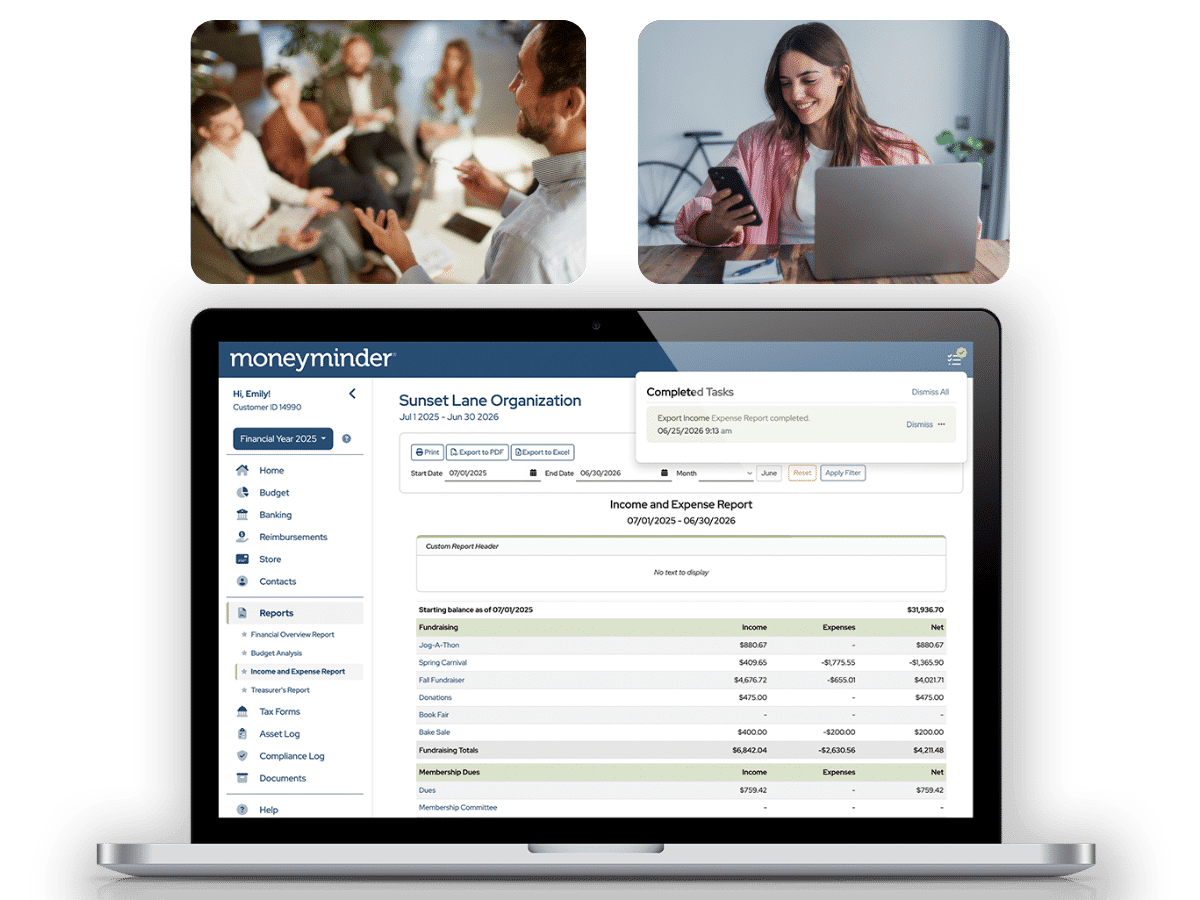
- College organization accounting software: Accounting software like MoneyMinder is purpose-built for the unique needs of sororities, fraternities, alumni groups, or other college organizations. It’s simple to use and at $299/year (less than $25/mo., billed annually) it’s budget-friendly.
Review your group’s financial records
Gather and review important financial documents from the previous year, quarter or semester, including:
- Bank statements
- Budgets
- Expense records
- Fundraising reports
- Outstanding financial obligations
As you review these records, make note of missing information or jot down any questions you might have. If possible, connect with the outgoing treasurer to fill in those missing pieces.
Create or review the budget
If there’s already a budget for the coming year, take time to review it. If you’re not sure about something, ask.
If the budget for the coming year hasn’t been created yet, take the lead on doing it. Start by reviewing the previous budget and how it compares to actual spending. Seeing where costs were higher or lower than expected can help you create a more realistic budget for the coming year. Also, keep in mind that costs tend to go up from year to year.
Every group’s budget will look different. But some common components include membership dues, event costs, awards, travel fees, and software expenses.

Update banking and account access
It’s important to keep group funds separate from personal finances. So if you haven’t already, now’s the time to open a dedicated bank account for your college group
It’s also important to make sure people have the right access to the group’s bank account, payment platforms, and accounting software. Remove access for past officers and make sure current leaders have the appropriate permissions.
Establish a reimbursement process
In some cases, an officer or member might make purchases on behalf of your group. But if you don’t have a reimbursement process, receipts and payments can easily get lost in the mix and members can get frustrated.
Before the start of the year, decide how you’ll handle reimbursement requests. Consider:
- How people will submit them
- Who must approve them
- How you’ll track them
Establishing a process now will reduce confusion down the road.
Compile a financial calendar
Map out important financial milestones for the year. Include items such as dues collection dates, fundraising events, recurring expenses, reporting deadlines, budget reviews, and tax filing deadlines. This calendar will help you plan ahead and avoid last-minute surprises.
During the School Year: Stay Organized
Once the school year starts, things tend to get really busy really fast. Taking some simple steps can help you stay organized despite the hustle and bustle.
Track money as it comes in
Use your chosen accounting method to track all forms of income that your group brings in, including membership dues, fundraising revenue, event fees, or donations. Categorize each source of income accurately in your budget.
Membership dues are often one of the largest sources of income for student organizations, so it’s especially important to record payments accurately and follow up on outstanding balances.
It’s important to track income as it comes in, rather than waiting until later. That way, you can avoid headaches later in the quarter or semester and have a true picture of your group’s financial position.
Record expenses right away
Track all expenses via your chosen accounting method and be sure each one is allocated to the right category in your budget. Whenever possible, save receipts and attach them to the corresponding transaction.
It’s also important to prioritize timely payment. Consistently paying the bills on time is key to building strong, long-lasting relationships with the vendors your group depends on.
Stay on top of reimbursements
Establish a routine for reviewing and approving reimbursement requests on a regular schedule. If you use a centralized system like MoneyMinder to collect receipts, track approvals, and record payments, things are less likely to slip through the cracks.
Reconcile your accounts on a regular basis
At least once a month, compare your financial records against your bank account activity to make sure everything matches up. This will help you spot errors early on, when they’re much easier to fix. It also gives you confidence that your financial reports provide an accurate picture of your group’s finances.
Provide regular financial updates
It’s best practice to provide a monthly treasurer’s report to the leadership team so everyone is on the page. Be sure to include income, expenses, starting and ending account balances, and budget progress. Having this information at the ready will help the entire team make better decisions throughout the school year.
End of School Year: Wrap Up and Plan Ahead
Just because the year is over doesn’t mean the work is. Take time to review your organization’s financial performance and prepare for what’s ahead. Taking some practical steps will make it easier to start the next year off on the right foot.
Review your financial performance
Compare your income and expenses against the budget you created. Looking back at your results can help you identify what’s working well and where there are opportunities to make improvements.
Resolve outstanding financial items
Make sure all income and expenses have been recorded and that any outstanding reimbursement requests have been processed. This is also a good time to verify that receipts and supporting documentation are attached to transactions and stored in a place that’s easy to find.
File tax forms with the IRS
If your organization has tax-exempt status, be sure you understand any annual filing requirements that apply to your group. Many tax-exempt organizations are required to file some version of IRS Form 990 each year to remain in good standing.
What are the most common version for IRS Form 990?
| Annual Gross Receipts | Form to File | Where to File |
| Normally $50,000 or less | Form 990-N (e-Postcard) | Online |
| Less than $200,000 in gross receipts and less than $500,000 in total assets | Form 990-EZ | Online |
| $200,000 or more in gross receipts or $500,000 or more in total assets | Form 990(long form) | Online |
Prepare for a leadership transition
If new officers will be taking over next year, make a plan to ensure a smooth handoff. Share financial records, explain key processes, and provide an overview of upcoming financial obligations and deadlines.
A smooth treasurer transition helps ensure the next treasurer can pick up right where you left off and your organization can continue operating without interruption.
To Do’s For a Smooth Treasurer Transition
| Before You Leave the Role |
| Reconcile all accounts |
| Process outstanding reimbursements |
| Create year-end financial report |
| Organize receipts and records |
| Transfer account access |
| Share budget and financial calendar |
| Meet with incoming treasurer |
Managing Your College Group’s Finances the Easy Way
Managing student organization finances is a big responsibility, whether you’re serving a sorority, fraternity, alumni association, or other college group. But it doesn’t have to be stressful.
By taking certain steps before, during, and after the school year, you can stay organized and confidently manage your group’s finances all year long. With the right systems in place, your organization will have the continuity, transparency, and long-term stability it needs for long-term success.
You don’t have to navigate the world of student organization finances on your own. MoneyMinder offers college group accounting software that can help you stay organized all year long. Ready to see how we can help? Start your 30-day trial to see how MoneyMinder takes the stress out of managing your college group’s finances.