
Key Takeaways
- An audit findings letter documents the results of a financial review and highlights any issues, concerns, or opportunities for improvement within an organization’s financial processes.
- In volunteer-led organizations like PTOs, PTAs, and booster clubs, findings usually relate to documentation gaps, inconsistent procedures, or internal controls — not fraud or misconduct.
- Audit findings letters help organizations strengthen financial accountability, improve transparency, and build trust with donors, parents, and the school community.
- Financial reviews and audit findings letters are especially important during treasurer transitions to help ensure continuity from one leadership team to the next.
- A strong audit findings letter should include audit logistics, a short summary, observations, recommendations, unresolved issues, storage details, and committee signatures.
- Financial review committees should be independent whenever possible and typically include volunteers who were not signers on the organization’s bank account during the review period, are not related or living in the same household, and are not the treasurer.
- Findings letters are most useful when organizations not only document issues, but also create and track corrective action plans to address them.
- Using organized financial systems and consistent recordkeeping throughout the year can make audits and financial reviews significantly easier and less stressful.
Stepping into a volunteer leadership role with a PTA, PTO, booster club, or other nonprofit is a great opportunity to make a major impact in your school or community. But with that opportunity comes certain financial responsibilities, which can feel like uncharted territory for busy volunteers who don’t have an accounting background.
Throughout your leadership term, you’re likely to come across tools and processes that can help support better financial processes, and some might be unfamiliar. An audit findings letter is one example.
In this guide, we’ll explore everything volunteer treasurers need to know about audit findings letters, including what they are, what they include, and why they matter.
What is an audit findings letter?
An audit findings letter is a document that’s compiled after an audit or financial review to outline any issues, concerns, or opportunities for improvement related to an organization’s financial practices. The letter is typically prepared after a thorough review of the organization’s financial records and processes.
In volunteer-led organizations like PTOs, PTAs, and booster clubs, audit findings letters usually focus on internal controls and financial procedures, not major financial misconduct.
For example, the letter might point out missing receipts, inconsistent recordkeeping, or opportunities to better separate financial responsibilities. In most cases, findings relate to process gaps or documentation issues rather than fraud or theft.
Most of the time, audit findings letters aren’t written to point fingers. More often, their purpose is to help volunteer-led organizations manage their finances more responsibly, avoid problems, and maintain stakeholder trust.
From time to time, you might hear audit findings letters referred to by other names, such as management letters, findings reports, or audit recommendation letters.
Why are audit findings letters important?
Let’s face it: anything with the word “audit” in it can feel intimidating. But in most cases, these letters aren’t something to fear.
That said, they are important and shouldn’t be overlooked. Let’s take a closer look at some of the key reasons why.
Uncovers issues before they grow into bigger problems
Audit findings letters can help volunteer-led organizations improve how they run. They’re usually meant to identify minor issues so they can be addressed before they grow into bigger problems that can financially impact the organization.
For example, a findings letter might highlight inconsistent recordkeeping or missing documentation. Neither of these findings necessarily suggests intentional wrongdoing. But when leadership teams are aware of issues and process gaps, they can address them before they become larger problems.
Builds trust
Audit findings letters also help build trust with donors and the school community by showing that the organization takes financial stewardship seriously.
Enables smoother treasurer transitions
Findings letters are also important during treasurer transitions, which are common in volunteer-led organizations. If issues aren’t properly documented and addressed, they can easily carry over from one leadership team to the next.
Who prepares audit findings letters?
Audit findings letters are typically prepared by the person or group conducting the audit or financial review. Depending on the size and type of organization, that could be a paid tax professional, an external auditing firm, or a volunteer committee.
In smaller nonprofits such as PTAs, PTOs, and booster clubs, findings letters are often prepared by a committee of volunteers that’s formed to review the organization’s records, bank statements, receipts, and financial procedures.
As a best practice, committee members should be made up of three volunteers who aren’t signers on the bank account during the period being reviewed. Typically, the treasurer helps assemble documentation for the committee and is available for questions. But the treasurer shouldn’t be present for the review itself, and they shouldn’t be involved in compiling the audit findings letter.
When are audit findings letters prepared?
An audit findings letter is an important deliverable for any financial review or audit. But when exactly do these take place?
Some types of nonprofits are required to conduct financial reviews at certain points in time throughout the year. But regardless of legal requirements, it’s best practice to conduct a financial review at the end of each fiscal year and whenever there’s a treasurer transition in your organization.
What should an audit findings letter include?
There’s no one-size-fits-all format that every organization must use. Audit findings letters will look different from one nonprofit to another.
That said, there are certain components that are important to include.
1. Audit logistics
This section lays out the who, what, when, why, and how of the review. Be sure to include the organization name, the treasurer’s name, the time period that was examined, and the date the review itself was conducted.
It’s also a good idea to include a couple sentences to describe what the committee reviewed during the process. That might include budgets, monthly treasurer’s reports, bank statements, deposit and expense documentation, and digital-payment platform statements.
2. A short summary
This section should provide a very brief overview of the review. Keep it to a sentence or two. Here’s an example: “The committee found the organization’s records to be substantially accurate and well organized.”
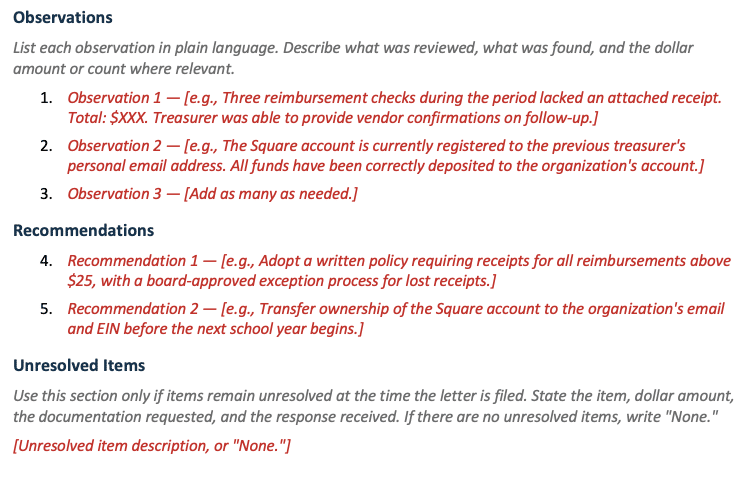
3. Observations
This is the section where you’ll list the committee’s findings. For each observation, describe what was reviewed, what was found, and the dollar amount or count, where relevant. Use language that’s easy to read, and include as many observations as needed.
Here’s an example: “Five reimbursement checks during the period didn’t have an attached receipt. Total: $298. Treasurer was able to provide vendor confirmations on follow-up.”
4. Recommendations
These are the actions the committee suggests based on the findings. Recommendations, like the rest of the letter, should be written using plain language.
Here’s an example: Develop a written policy requiring receipts for all reimbursements over $25, with a board-approved exception process for lost receipts.
5. Unresolved issues
This section should be used to document items that are unresolved at the time the letter is filed. Include the item, dollar amount, the documentation requested, and the response received. If there aren’t any unresolved items, the committee can simply write “None” in this space.
6. Storage and access
Briefly describe where the audit findings letter is stored and who has access to it. Here’s an example: This review is filed in the organization’s critical documents binder and shared with the full board via Google Drive.
7. Committee signatures
Include printed names and signatures for all members of the financial review committee.
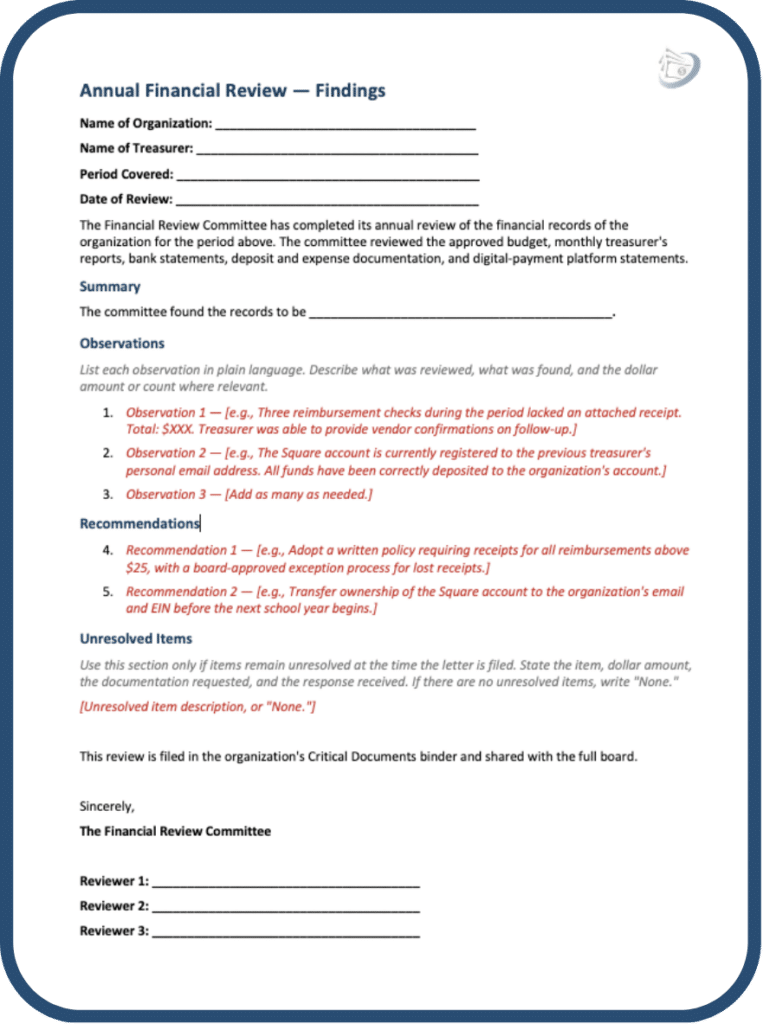
Sample Audit Findings Letter
Not sure what an audit findings letter is supposed to look like? You’re not alone. Many volunteer leaders step into treasurer and financial review roles without ever having seen one before. That’s why having a clear example can make the process feel much more manageable. This sample audit findings letter can help your team understand how to organize findings, document recommendations, track unresolved items, and create a clear financial record for future leaders.
Keep in mind that every PTO, PTA, booster club, and nonprofit will have slightly different financial procedures, so your final version may look a little different. The goal isn’t perfection — it’s creating consistent documentation that helps strengthen accountability and supports smoother leadership transitions year after year.
Want a version you can customize for your own organization? Download the complete year-end success kit. Inside the audit guide, you’ll find a link to an editable version of this sample so you can tailor it to your organization’s needs and make it your own.
What happens after an audit findings letter is drafted?
Once the audit findings letter is compiled, signed and presented to the board, it should be stored in a centralized location, such as the organization’s critical documents binder. The findings should also be shared with the board or key volunteer leaders.
From there, the leadership team can review the findings and discuss next steps for addressing them. That could include anything from improving documentation practices to updating financial procedures to organizing records more consistently. It’s important to develop a plan for addressing any recommended improvements and make sure everyone knows who’s handling what.
It’s also important to document any corrective actions that are taken. A clear record of how findings were addressed will help future leaders understand past issues and prevent them from happening again.
Close out the year the right way
Audit findings letters can seem intimidating. But they’re actually one of the most powerful tools for improving how an organization runs.
The good news is that you don’t have to reinvent the wheel next time a financial review comes along. Download our free year-end success kit for volunteer treasurers, where you can access an audit findings letter template and other tips and tools for wrapping up the year the right way.

MoneyMinder makes audits a breeze
Regular audits are an important way to set your organization up for long-term success. And the process doesn’t have to be overwhelming.
By keeping your books organized throughout the year, financial reviews and audits can be straightforward and stress-free.
Ready to see firsthand how MoneyMinder can help your organization stay organized so there are fewer surprises during audit time? Start your free trial today.