
Key Takeaways
- Treasurer transitions are a normal—and unavoidable—part of school-based parent groups like PTOs, PTAs, and booster clubs. Planning for them should be standard practice, not an afterthought.
- During a treasurer’s term, valuable knowledge is built over time. Without a clear transition process, much of that insight can be lost, creating unnecessary confusion for the next volunteer.
- Start the transition early—ideally before the school year ends. Once a treasurer steps down, they’re often no longer available to answer questions or provide support.
- Maintaining continuity is essential. Using a tool like MoneyMinder helps keep financial records, reports, and processes organized in one place, with secure access for multiple users and customizable permissions.
- To make the process even easier, MoneyMinder offers a free printable year-end checklist to guide your treasurer transition from start to finish.

15 Tips for a Smooth Treasurer Transition
For PTOs, PTAs, and other parent groups, treasurer transitions are inevitable. Kids graduate or move on to different activities, terms come to a close, and the time comes to pass the torch.
A new treasurer can bring fresh perspective and energy to the PTO. But there’s no denying that treasurer transitions can also be stressful. When handoffs are disorganized, new treasurers may struggle to find their footing. And that can have a major impact on continuity, compliance, and trust.
The good news is that with some thoughtful advanced planning, a smooth treasurer transition is within reach. Use this guide to make sure nothing slips through the cracks and that your new treasurer is ready to hit the ground running.
1. Start Early
One of the biggest (and most common) mistakes PTOs make is waiting until the last minute to start the transition process. At that point, there’s not enough time to organize records, transfer knowledge, and answer questions. As a result, new treasurers often find themselves fumbling.
You can avoid this situation by starting the transition process well in advance. How much time should you allow? At least one month of transition time is ideal, as it allows the incoming and outgoing treasurers to work together during the overlap period. The incoming treasurer will have plenty of time to learn and ask questions so they can confidently step into their new role with their responsibilities clearly understood.
Beginning this process before the school year is over is especially helpful, as it provides a natural window for collaboration. Too often, once a treasurer steps down, they are no longer readily available.
2. Establish a Transition Timeline
PTO treasurers have busy lives outside of their volunteer roles, and it’s easy for time to slip away. To keep things on track, map out a simple transition timeline with key items including:
- When the books will be finalized
- When reports will be shared with the board
- When access to accounts and tools will be transferred
- When the official handoff will take place
A clear, simple timeline will set expectations, keep the outgoing and incoming treasurers aligned throughout the transition, and reduce last minute scrambling.
3. Clean Up and Close Out the Books
If you’ve ever inherited messy, disorganized books, you know how overwhelming it can feel. It’s hard to know where to start.
Take the time to ensure your organization’s books are accurate and up-to-date before handing them over to the new treasurer. Complete and audited books will give the new treasurer a solid foundation for a strong year ahead.
Start by reconciling all accounts, including bank accounts and any payment platforms. Also, confirm that all transactions are recorded, categorized correctly, and match your statements.
If any discrepancies or issues crop up, try your best to solve them prior to handoff. If that’s not possible, document where the issue stands and what needs to happen next so the new treasurer isn’t caught off guard.
4. Resolve Outstanding Obligations and Reimbursements
Before you hand over the reins, close out any pending financial items. For example, pay and record all outstanding bills and complete any reimbursement requests.
If there’s anything you’re not able to wrap up before the transition, but sure to clearly document it so the new treasurer knows what’s owed to who and when it’s expected.
5. Prepare a Clear Financial Snapshot
It’s also helpful to provide the incoming treasurer with a snapshot of the parent group’s financial position. This helps them understand where things stand today and what’s coming up.
A financial snapshot should include information such as:
- Current account balances
- Budget vs. actual spending
- Recent fundraising results
- Any major upcoming expenses
Don’t overcomplicate it. A quick summary paired with your latest reports will provide the incoming treasurer with important context that will boost their confidence as they step into their new role.
6. Stay Ahead of Expirations
Conduct a thorough review of all subscriptions, licenses, and financial tools tied to the treasurer role—especially the MoneyMinder account—and renew them well before the school year wraps up. MoneyMinder invoices are generated in your account 60 days prior to your account expiration.
Taking care of subscription renewals early ensures uninterrupted access for the incoming treasurer and avoids any last-minute scrambles, login issues, or gaps in financial tracking during the transition.
7. Transfer Access to Software and Tools
Most PTO and PTA treasurers rely on certain accounts and tools to fulfill their duties. Ensure the incoming treasurer has access to these so they aren’t left scrambling after you’ve transitioned off the board.
Update authorized users and transfer admin access for key resources, including:
- PTO treasurer software like MoneyMinder
- Payment platforms
- Shared email accounts
- File storage
Once the incoming treasurer has the right access, you can remove your permissions where appropriate. This prevents confusion and helps maintain a clean, secure system.
8. Update Bank Accounts
Ensure bank access is properly transitioned by removing outgoing treasurers and adding the new treasurer. Complete and submit a new bank signature card as required.
Taking care of this early helps avoid delays in payments, deposits, or reimbursements.
9. Review Compliance Requirements
Often, the treasurer plays a major role in fulfilling compliance requirements. So make sure the incoming treasurer understands what those responsibilities are to avoid problems down the road.
Review key items such as your EIN, IRS filing status, state registration, and any applicable tax obligations. Be sure to discuss your annual 990 filing, including:
- Which version to file
- When it’s due
- What information they’ll need for filing
- Any login information they’ll need to complete the filing
10. Cover Insurance & Legal Responsibilities
If your PTO has insurance (as it should), be sure to review the policy details with the incoming treasurer and update the officer list if required. Taking the time to cover these legal and administrative responsibilities ensures continuity and reduces risk after the transition.
11. Create a Treasurer Calendar
There are several dates and deadlines that are important for PTO treasurers, including:
- Form 990-N or 990-EZ filing
- Budget planning
- Major events
- Reporting cycles
- Software renewals, such as MoneyMinder
- Insurance renewals
- Licensure such as your charitable solicitation
- Annual state renewals
- Annual financial review or audit
When a new treasurer is busy getting up to speed, it’s easy for one of these important deadlines to slip through the cracks. Putting together a simple treasurer calendar or timeline can help them stay on track as they’re ramping up in their role.
The MoneyMinder compliance log is a handy place for keeping track of key dates and deadlines in one central place.
12. Walk Through Processes
Written documentation is important, as we covered earlier in this checklist. But hands-on guidance makes theoretical information a lot more concrete.
Walk through the processes and scenarios the new treasurer will encounter on a regular basis, such as:
- Recording transactions
- Reconciliation
- Processing reimbursements
- Generating reports
Talk through each scenario, let them do the work while you observe, and encourage them to ask questions along the way. Incoming treasurers will retain more information and be better prepared to tackle real-life processes and scenarios right away.
Be sure to gather and organize key records including budgets, bank statements, receipts, invoices, account information, and tax statements.
When records are organized and processes are well-documented, the new treasurer can pick up right where their predecessor left off, without having to reinvent the wheel.
13. Share Lessons Learned and Best Practices
Outgoing treasurers know the ins and outs of the role better than anybody else. So be sure to share your personal experiences with your successor.
Discuss what worked well, what didn’t, any major hurdles you faced, and how you overcame them. For example, you might share tips for navigating tax obligations, managing the finances for a large fundraiser, or keeping everything organized throughout the year.
14. Communicate the Transition to the Board
When a new treasurer is elected or appointed (depending on your bylaws), it’s important to communicate the transition to the board. Walk through the roles and responsibilities, share the transition plan, and discuss any immediate priorities or deadlines.
Give the board an opportunity to get to know the new treasurer (and vice versa), and encourage them to offer their support as they step into the role. This will help support a smooth handoff and reinforce trust in the organization’s financial leadership.
15. Complete the Final Handoff and Offer Your Support
Make sure all responsibilities, materials, and access have been fully transferred to your successor before you make your official exit. Don’t forget to hand over physical supplies like checkbooks, deposit slips, and endorsement stamps.
Schedule a quick check in for a few weeks after the new treasurer has officially taken over. You might also share your contact information so they can reach out with any questions during their first few weeks on the job.
Printable Year-End Checklist for Treasurers
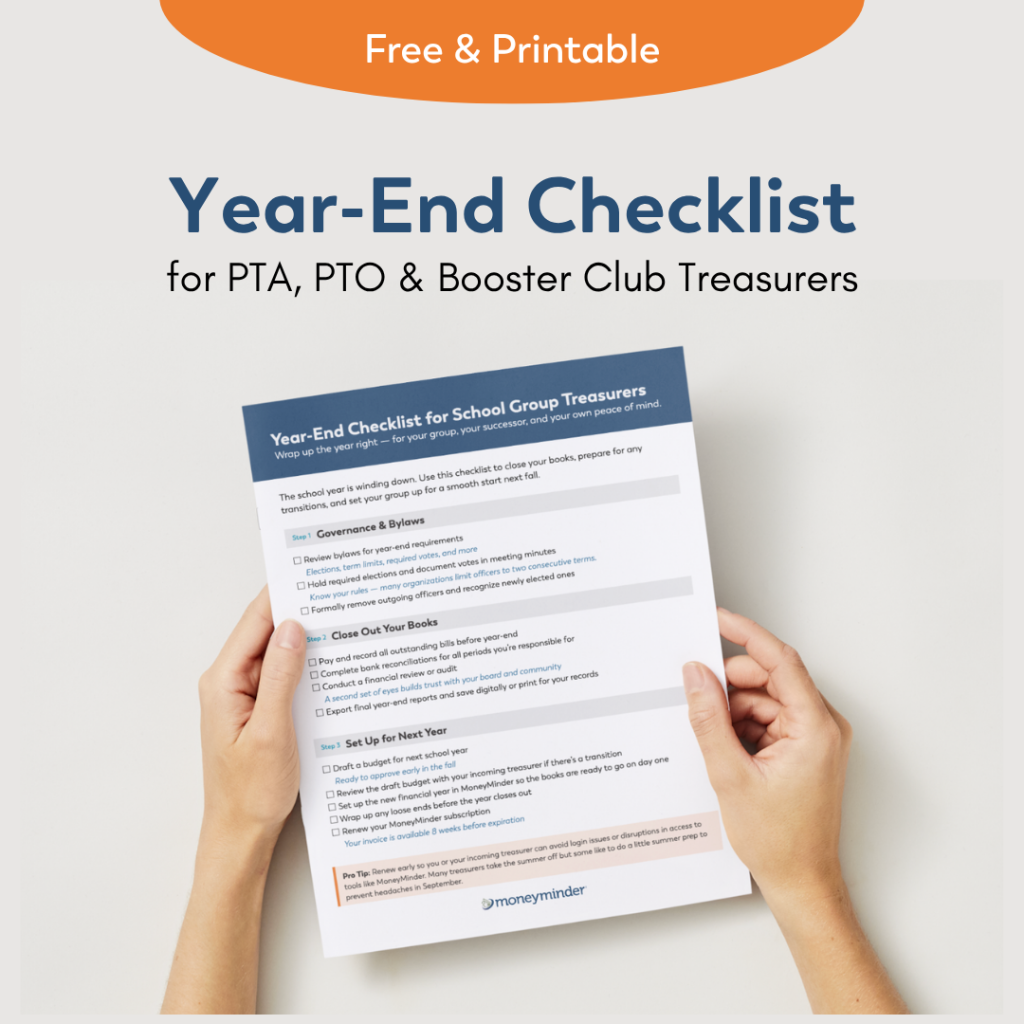
You made it — the school year is officially winding down, and you’ve kept the books humming through every fundraiser, field trip, and last-minute reimbursement request.
Now it’s time to close things out with the same care you brought to the rest of the year. This year-end checklist for treasurers walks you through everything you need to wrap up cleanly, stay in good standing with the IRS and your bank, and set next year up for success — whether you’re transitioning treasurers or not.

How MoneyMinder Makes Treasurer Transitions Easier
Treasurer transitions are a fact of life for PTOs, PTAs, and other parent groups. But they don’t have to be stressful or disruptive. By taking a thoughtful, structured approach, your incoming treasurer will be ready to pick up where their predecessor left off, and your organization can continue making an impact without disruption.
Ready to see how MoneyMinder helps PTOs, PTAs, and booster club treasurers stay organized, accountable, and confident all year long? Start your free trial today.

Treasurer Transition FAQs
No — once a treasurer steps down, their access to the organization’s bank account should be removed promptly. Leaving a former officer on the account creates legal and financial liability for both the individual and the organization. Submit an updated signature card to the bank as soon as the new treasurer is in place, and confirm in writing that the outgoing treasurer’s access has been revoked.
Start with this article: how to get started if the outgoing treasurer is not helpful. Gather whatever you can from the bank, IRS, and any existing software accounts. Pull recent bank statements, request copies of past 990 filings from the IRS website, and contact your insurance company and state for current officer records. Reach out to other current and former board members for any documentation they may have. Once you’ve reconstructed what you can, document everything thoroughly so the next treasurer doesn’t face the same problem.
If your PTO, PTO or Booster Club is a 501(c)(3) tax exempt organization, you don’t need to notify the IRS immediately when officers change, but you’ll need to update your principal officer information when you file your next annual 990-N or 990-EZ.
This is a smart practice and one many bylaws actually require. Having both treasurers sign the year-end report acknowledges that the outgoing treasurer is presenting accurate, complete books and that the incoming treasurer has reviewed and accepted them. It creates a clear record of accountability and protects both individuals from future questions about the state of the books at handoff. Rules vary by organization. Be sure to check your bylaws.
A treasurer transition is the operational handoff of duties, access, and knowledge between two volunteers. A financial audit (or financial review) is a formal examination of the organization’s books to verify accuracy and proper handling of funds. The two often happen around the same time, and many PTOs require an audit at the end of each fiscal year or whenever the treasurer changes. Audits are typically conducted by an audit committee of members who are not signers on the bank account.
Yes, many PTOs and booster clubs use a co-treasurer structure to share the workload and build in continuity. Co-treasurers can divide duties — one handling deposits and reimbursements while the other manages reporting and reconciliations, for example. This setup also makes future transitions smoother because there’s always someone with current knowledge of the books. Just make sure your bylaws allow for co-treasurers and that both individuals are properly added as authorized signers on the bank account.