
How to handle Budget carry forwards from prior years
Watch Video
There are times when an activity does not use all its allocated funds during the year it was budgeted for. Some groups consider that unused money something to be carried over and used in the next financial year.
For example, you may have budgeted $1,000 for a special project, and only $600 was spent. But you want the remaining $400 to be available next year. You may also budget an additional $1,000 for that special project next year. That would mean your project would have $1400 to spend in this scenario.
Here’s how we recommend handling that:
Click Budget in the sidebar.
Click Add Heading.

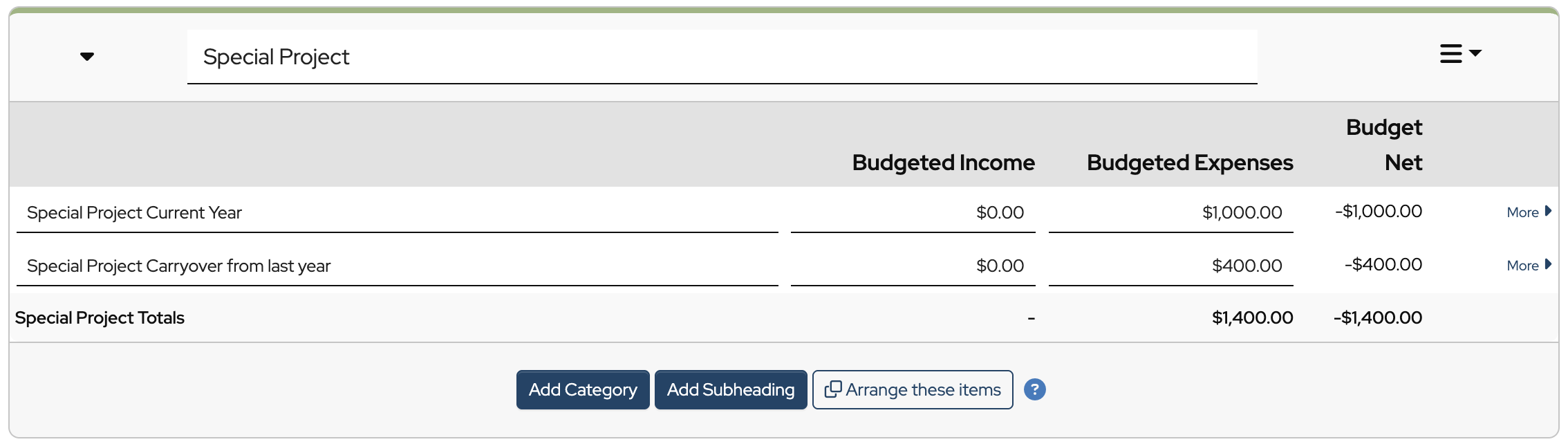
Name the Heading something like Special Project. Add two Categories called Special Project Current Year and Special Project Carryover from Last Year.
The first Category would have $1,000 in the Budgeted Expenses column, covering the new funds for this year.
The second Category would have $400 in Budgeted Expenses, taking care of the remaining funds from last year.
Make sure to use the Budgeted Expenses column for these entries. It means that you have that money available to spend.
Click Save Changes when you are finished setting this up.
Now, when you have $400 worth of expenses for the Special Project, you can allocate them to the Special Projects Carryover from last year category. Anything more would go against this year’s budget.
As that money is spent, the remaining balance can be tracked in the More/-Less column in the Treasurer’s Report.

This shows that $275.00 of the $400 has been spent in the Special Project Carryover from last year category, so there is $125.00 left to spend.
You can also see the total remaining balance for the Special Project heading in the More/-Less column in the Totals row.

$1,400 is available to spend between the two categories. $275 has been spent so far, so there is $1,125 left to spend in Special Project.

*Watch this longer video for more examples of when and how to use budget carry forwards.
How can I carry over funds held in trust for a project and still maintain a balanced budget? When using the above example, it increases my overall expenses, but there is no actual new year income intended to balance it.
Hello Mrs. C., Yes, you would have a budget category line for restricted carry over funds and by putting those dollars in budgeted expense you are saying those are funds that you have in the bank to spend. These funds are a carryover and are reflected in the Funds Available at beginning of financial year when you carry your banking over. If these are restricted funds that are for only one purpose, you might like the option of showing those funds separately (even though they are part of your bank account). I will give you a knowledge base link to show you how this is easily done. Please let us know if you have any further questions, we are happy to help! Warm regards, Julie
https://moneyminder.com/knowledgebase/how-to-handle-restricted-funds/
I face the same challenge as Mrs. C and expect to carry these restricted/trust funds forward for many years spending only a portion in any particular year. While the total “carryover/trust” funds are present in the beginning balance for the year and will appear at the top of the budget report, there is no accounting for how these funds are allocated between projects. Julie’s suggest to add a budget line for each of these projects is great, but entering the full carryover amount as the expense amount distorts budgeted expenses for the year unless you expect to spend the full amount in the year, which I do not.
To account for the availability of carryover/trust funds in the new year’s budget I add a line(s) to the budget with the name “Restricted Funds – Project A (YYYY Starting Balance $$$$)” and enter an expense value corresponding ONLY to the amount we expect to spend in the budget year. In this way, I show my audience both the total amount of funds available for the project and the portion we expect to spend this year.
At year end, the Treasurer’s Report shows me the actual amount spend for each these projects and I can see the corresponding starting balance (annotated in the name for each project), permitting me to determine the carry over amounts for next year’s budget.
Great article – thank you for sharing!
Hello, my question is similar to those above (I think). Our budget year ends (swim club) with the calendar year. However, we have a yearly payment option for the upcoming year (2026) that opens in December 2025, as well as a clinic in early January 2026. For the yearly option, we give the swimmers until January 31 to pay, and some clinic payments will hit our bank account in early January as well. So, we have some income for 2026 events coming in 2025, and the rest coming in 2026. How can I record this so that a 2026 Treasurer’s Report shows ALL the money we received in both years? I used the above “carry forward” approach for a swim meet in January 2026 for a swim meet that opened for registration in November 2025, but Im not sure if I did it correctly. the numbers all add up in the “More/Less” column on the Treasurer’s Report, however.
Hi Doug,
Any income you received in 2025 for 2026 will be entered into your 2026 budget in the budgeted expense column. That’s because it’s money you already have to spend, not money you expect to bring in in 2026.
You did a good job in your budget with the categories, but the amounts are entered in the wrong column. For instance, (TS2026) Meet Entries from 2025 the $2025.00 should be entered into the Budgeted Expense column instead of the Budgeted Income column, the same for T-shirt Sales from 2025.
The expenses that were recorded last year will go into the budgeted income column. So the Club Assistant Processing Fees in 2025 $132.84 should be entered in the budgeted income column, the same for Stripe Processing Fees in 2025.
Then you can continue entering income and expenses in your 2026 year, and the More/Less column will track correctly.
Feel free to contact us through Live Chat if you have more questions.
Thanks!