
Keeping a Treasurer’s Name Out of the Evening News
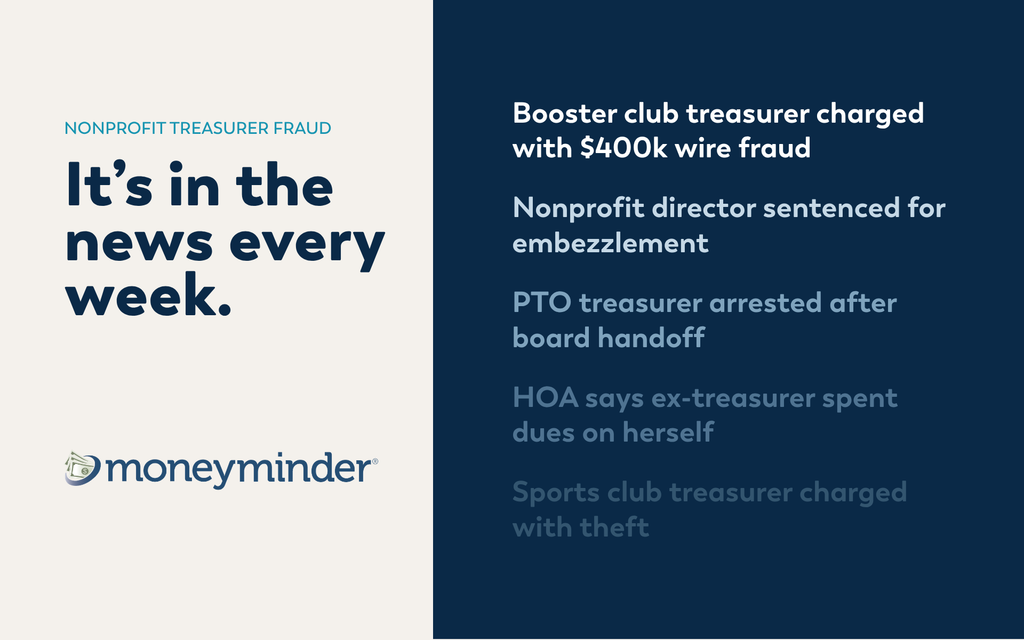
Have you noticed how often nonprofit treasurer fraud makes the news? It’s more often than you’d think — and these are only the ones that made it past a local news desk:
In September 2026, federal prosecutors charged the former treasurer of a California high school football booster club with wire fraud, alleging she took roughly $411,000 from the club over two years to pay her mortgage and credit card bills. The indictment says she concealed it by emailing the board treasurer’s reports that left the missing money out. (ABC News)
A month earlier, the former executive director of a Habitat for Humanity chapter in Arizona was sentenced to 62.5 years in prison for embezzling about $826,000. Investigators found she had used the nonprofit’s accounts to buy vehicles and pay her own mortgage, and had opened an unauthorized credit card in the organization’s name. It came to light through an anonymous tip. (KTAR)
And in March, a Nebraska PTO treasurer was arrested after police determined she had spent nearly $15,000 of the group’s money on personal purchases over two years. The discrepancies surfaced during the ordinary summer board handoff, when new officers looked at the records. (KOLN)
The amounts vary wildly. The pattern doesn’t. One person had sole control of the money, nobody independently checked their work, and it ran for about two years before something unrelated exposed it: a tip, a board transition, a bank noticing.
That’s the useful part, because it’s the part you can change. The controls below are ordinary and mostly free, and they do two jobs at once. They make theft hard, and they make it impossible for an honest treasurer to be suspected of something they didn’t do.
Preventing Fraud and False Accusations
Despite the stories above, it remains true that most nonprofit fraud isn’t a scheme. It’s a treasurer who covered a $40 supply run out of the group’s account and meant to pay it back, and then didn’t. It’s a cash box that went home in someone’s car. It’s a deposit that nobody counted twice.
Small organizations are especially exposed. The money runs through a handful of volunteers, there’s no finance department looking over anyone’s shoulder, and turnover means institutional memory walks out the door every year or two.
But prevention isn’t only about catching dishonest people. It’s about protecting the honest ones. When a treasurer can’t prove where the money went, they’re vulnerable to accusations they don’t deserve. Good controls give every volunteer a clean record to stand on.
Separate Duties
The single most effective control is making sure no one person handles a transaction start to finish.
- Always have two people count money, and use a standard counting sheet both counters sign.
- Reconcile what you collected against what you banked. If 12 members signed up at $10 each, $120 should hit the account.
- Give receipts for money received. A copy of the counting sheet works.
- Require two signatures on checks. Many banks won’t enforce this, but you can verify it after the fact against check images.
- Have a non-signer verify the bank statement. A board member who isn’t on the account compares the statement to the treasurer’s report every month and signs off that they did.
- Use a check request form for every disbursement, with the receipt attached. No form, no check.
- Don’t pay for things with cash, and keep all voided checks rather than destroying them.
The last three — independent review, a check request form for every disbursement, and keeping voided checks — are what auditors and insurers look for. They’re also the ones most often missing when something goes wrong.
Reconcile Monthly
Reconciliation does two jobs. It catches honest mistakes — a transposed amount, a wrong date, a miscategorized transaction — and it closes the window on dishonest ones.
Errors are cheap to fix now and expensive to fix later. If an audit committee finds a problem from November in April, someone has to reconstruct five months of activity to correct it.
The fraud protection works differently. Once a month is reconciled, the records are locked to the bank’s version of events. Changing anything after that means unwinding every month back to the error — and in MoneyMinder, that unwinding is recorded in the Event Log as a recordable event. Nothing gets quietly edited. That transparency is the point: it doesn’t make tampering impossible, it makes it visible.
Reconcile when the statement arrives, every month, without exception. A bank feed that pulls transactions in automatically removes most of the manual entry where errors start.
Close the Digital Gaps
The controls above were built for a world of paper checks and cash boxes. Most of the risk has moved:
- Never route group money through a personal Venmo, Zelle, or Cash App account. It’s the most common way funds go missing in volunteer organizations, and it’s nearly impossible to audit. Use a payment tool tied to the organization’s own account.
- Give the board view-only access to the books instead of sharing the treasurer’s login. Shared credentials destroy the audit trail — every action looks like it came from the same person.
- Watch for payment scams aimed at your board. A text from “the president” asking someone to buy gift cards, or an emailed request to change a vendor’s bank details, should always be confirmed by phone using a number you already have.
- Turn on bank alerts for large withdrawals and low balances so more than one person sees unusual activity in real time.
Keep Records Others Can Follow
You need to be able to answer “what was this $340 for?” two years from now, when a different treasurer is asking.
Digital records handle this better than binders ever did: statements, reconciliations, receipts, and treasurer reports stored with the transactions they belong to, accessible to the next person without a box handoff. If you’re still on paper or spreadsheets, at minimum make sure a second board member has copies.
Make it a Policy
Controls that live in one volunteer’s head disappear when that volunteer does. Put the handful above into a short written financial policy, have the board approve it, and review it whenever the treasurer changes.
What Would’ve Caught These Fraud Cases Sooner?

Every month, hand one board member who isn’t on the bank account two things: the bank statement and the treasurer’s report. Ask them to confirm the two agree, and sign that they did.
It takes about ten minutes. Our free Treasurer’s Report Guide includes the 10-minute review form to do it with, plus sample monthly and annual reports.
MoneyMinder gives volunteer treasurers reconciliation, an event log, board-level access, and the reports this review runs on — built for groups exactly this size. Start a free trial →