
Trying to pick the best way for your group to collect payments or donations in 2027? There are many options, including cash, checks, Venmo, Stripe, PayPal, and Cheddar Up.
But while there’s no shortage of nonprofit payment platforms, choosing the right one can be confusing. Each option has different features and fees. And as a nonprofit, you need a solution that makes it easy to collect payments, track every dollar, and maintain accurate records.
In this guide, we’ll walk you through the factors to consider when choosing a nonprofit payment platform in 2027 and explore how some of the most popular options measure up.
Nonprofit Payment Platforms at a Glance
Here’s a quick snapshot of some of the most popular nonprofit payment platforms for 2027. Later in this guide, we’ll take a closer look at each option.
- Cheddar Up: Easy for everyone, low fees, works smoothly with MoneyMinder.
- Stripe: Flexible and reliable, solid for online payments.
- PayPal: Widely used but sometimes charges more in fees.
- Square: Great for in-person payments, also solid online.
- Donorbox, Givebutter, Snowball: Focus on events and campaign fundraising.
- Venmo, Zelle, CashApp: Convenient for peer-to-peer, trickier for nonprofits.
- eCheck or ACH: One of the cheapest ways to move big amounts.
- Plain old cash and check: No fees, but extra work to track everything.
What to Consider in a Nonprofit Payment Platform
Not sure which payment platform is right for your group? Here are five things to keep in mind as you weigh your options.
Fees: Processing fees can add up fast. Some platforms are flat-rate, while others take a percentage. Lower is better, especially for big donations.
Donor experience: Is it easy to pay? Can someone just click a link or do they have to create an account or download an app?
Nonprofit features: Think about things like event sign-ups, inventory, signatures, or recurring payments. Also, remember that platforms designed for businesses may include expensive features you don’t really need.
Compatibility with MoneyMinder: The fewer things you have to do by hand later, the better.
Reputation: Choose something that has been around a while, so your group won’t get stuck if the platform disappears.
Side-by-Side Nonprofit Payment Platform Comparison
With so many nonprofit payment platforms available, it can be helpful to see a side-by-side comparison. Here’s a look at what some of the most popular options cost, how donors can pay, and what features and integrations they offer to nonprofit organizations.
| Platform | What nonprofits pay | How donors pay | Notable features and specialties | MoneyMinder integration |
| Cheddar Up | 3.99% + $0.59 per card payment*; 0.4% + $0.95 per e-check | Pay by card or bank account; no app or account needed | Collects signups, waivers, inventory, e-signatures automatically; included free with a MoneyMinder team plan | Payments, donor info, and custom data flow straight into MoneyMinder Store |
| Stripe | 2.2-2.9% plus $0.30 per transaction; no monthly fee | Pay by card or digital wallet; no app or account needed | Supports recurring gifts, advanced security tools | Connect Stripe account to import transactions directly to MoneyMinder |
| PayPal | 1.99-2.89% plus $0.49 per transaction; no monthly fee | Pay by card, PayPal balance, or bank account; may need PayPal account | Adds “Donate” buttons; provides invoicing and payment links | Connect PayPal account to import transactions into MoneyMinder |
| Square | 2.6-2.9% plus $0.10 or $0.30 per transaction; no monthly fee | Pay by card; no app or account needed | Strong for ticket sales, event payments, quick reports | Connect Square account to import transactions into MoneyMinder |
| Donorbox | 1.75% platform fee plus payment processor fees | Pay by card, bank transfer, or PayPal; no app or account required | Custom donor forms, donor database | Secure file upload |
| Givebutter | Free if donors tip to cover fees; else about 2.9% on cards | Pay by card, bank, PayPal, Venmo; no app or account needed | Ticket sales, event and campaign management | Secure file upload |
| Snowball | 2.9% plus $0.30 per transaction; monthly fee for extras | Pay by card; no app or account needed | Peer-to-peer fundraising, easy mobile donation tools | Secure file upload |
| GiveLively | No platform fee; standard card fee (around 2.2-2.9%) | Pay by card, bank, PayPal; no app or account needed | Text-to-give, digital campaign features | Secure file upload |
| Zeffy | Zero platform fee; donors can tip to cover card fee | Pay by card; no app or account needed | Only platform covering card fees with optional tips | Connect Zeffy account to import transactions into MoneyMinder |
| Givebacks (formerly MemberHub) | Varies by tool: store items 3.95% + $0.95; direct donations 1.99% + $0.49; campaigns 2.9% + $0.30 on the free “tip” model, or 10.4% + $0.30 all-in on percent pricing | Pay by card; no app or account needed | Built for PTAs, PTOs and school groups, with member management, online store, raffles and “shop to give” rewards | Download a payout summary from Givebacks and import it into MoneyMinder |
| Venmo | 1.9% plus $0.10 per transaction | Pay with Venmo; Venmo app and account required | May increase visibility by appearing in donor’s social feed | Secure file upload |
| CashApp, Zelle | Varies; may have app or bank fees | Donors must use respective apps and have an account | Simple peer-to-peer options, limited business features | Secure file upload |
| Cash, check | No fees, just bank limits | Pay in person with cash or check | No fees | Secure file upload |
| eCheck | About 0.7-1% per transaction, often capped at a low amount | Pay electronically with bank account | Low-cost ACH transfer, good for large donations | Automatic (via Cheddar Up Store) or secure file upload |
*These Cheddar Up fees include the MoneyMinder 0.4% platform fee which gets you the powerful Team edition for free, a $48/mo. value.
A Note About “Tipping” Based Payment Tools
As you can see in the table above, many payment platforms are adding tip prompts during the checkout process. While the idea of “just add a tip” may seem appealing, you don’t want to risk confusing your donors or supporters into thinking the tip is going to your nonprofit instead of the payment platform.
Some of these apps don’t make it obvious to the end user how to opt out of the default tip, which can sometimes be set quite high. So just a word of caution to proceed carefully to avoid eroding donor trust.
Why Cheddar Up is a Favorite for Groups
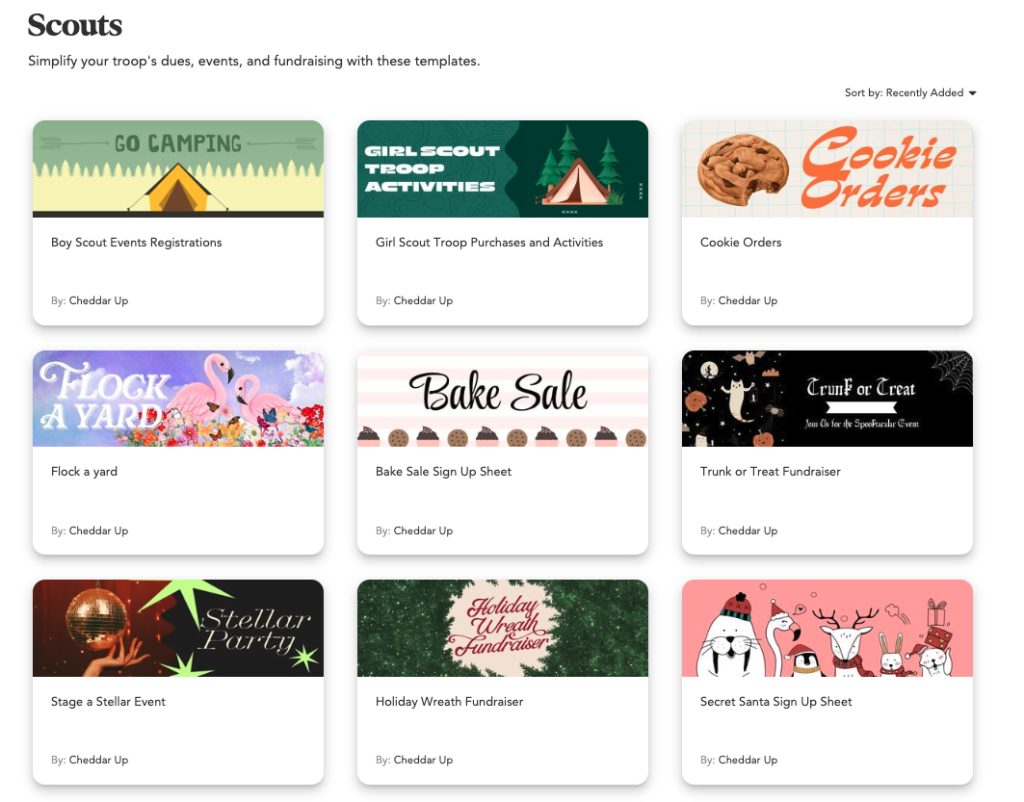
If you want something that works for everything from dues to events to T-shirt sales, Cheddar Up is tough to beat. Donors can pay without an account or app, which makes life much easier for everyone.
You get signups, signatures, inventory tracking, waitlisting, ticketing, a gift card store and easy reporting, all in one spot.
Best of all, if you use MoneyMinder’s store with Cheddar Up, your payments flow straight into your books—no need to enter them in both places.
Other Big Names to Consider
Several other payment platforms are worth considering, each with its own pros and cons.
- Stripe and Square: These are the go-tos if you have decent tech support and plan to process payments both online and in-person.
- PayPal: It’s familiar, but fees can be higher and some donors find it clunky.
- Donorbox, Givebutter, Snowball: Designed for online fundraising drives, often with extra campaign tools.
- Venmo, Zelle, Cash App: Familiar and easy for the donor, but hard to track without a system.
- eCheck/ACH: A good fit for large gifts because it costs significantly less per dollar.
It’s Not Just About Collecting Payments
A lot of groups stop at “how do we collect money?” But it’s also important to think about how you’ll handle those payments on the back end. That’s where your financial management platform comes in.
A true financial management tool helps you generate reports, create and track budgets, handle tax reporting, and stay compliant. Choosing a payment platform that talks to your accounting system will save you hours and headaches.

See how MoneyMinder and Cheddar Up can simplify managing your nonprofit’s payments and finances with a free 30-day trial.
Frequently Asked Questions About Nonprofit Payment Platforms
The best online payment platform for small nonprofits depends on the group’s needs and budget. When weighing your options, consider transaction fees, ease of use, and how easy it is to track payments in your accounting software. Cheddar Up is a popular option for nonprofits that want to collect payments, donations, and event registrations in one place.
Yes, some payment platforms offer free plans to nonprofits. For example, Zeffy covers transaction fees through optional donor tips, and Givebutter is free if donors tip to cover the fees. Be sure you fully understand the costs of any payment platform you’re considering. Some platforms advertised as “free” actually charge credit card processing fees, transaction fees, or fees for more advanced platform features.
Consider offering multiple payment options so supporters can pay the way they prefer. Credit and debit cards are an easy way for supporters to pay online, while ACH bank transfers can be a more affordable choice for larger donations. PayPal and Venmo are convenient for supporters who already use them, and cash and checks may be an easy method for those attending in-person events.
Yes, nonprofits can accept donations through Venmo, Zelle, or Cash App, as long as they use an eligible account and follow each platform’s rules. These apps are familiar and easy for donors to use, but they don’t necessarily have the features nonprofits need, like donor tracking and fundraising reports. If your nonprofit uses any of these apps, make sure you have a system in place to track donations and keep your financial records up to date.
Nonprofits that collect payments through multiple channels should have a system for keeping transactions organized and up to date. Nonprofit accounting software like MoneyMinder can help you track payments and donations in one place. MoneyMinder integrates with popular platforms like Cheddar Up, Stripe, PayPal, and Square, so it’s easier to import transactions and keep your financial records up to date.