
Key Takeaways
- In-kind donations are gifts of goods, services, or the use of property instead of money, such as raffle prizes, school supplies, or donated meeting space.
- Record in-kind donations at their estimated fair market value, meaning what the item would sell for in its current condition, and keep notes on how you got that number.
- Donors need a written acknowledgment for any single gift of $250 or more to claim a tax deduction.
- Acknowledgment letters should describe the donated item but never include its dollar value. Valuing the gift is the donor’s job.
- MoneyMinder can generate donation acknowledgment letters from the donations you’ve recorded, one at a time or in bulk.
The word “donation” is often associated with cash, checks, and credit card contributions. But not all donations come in the form of money. A local business might donate an item for a gift basket raffle, or a professional might volunteer their time to design promotional materials for an upcoming fundraiser. Both of these are examples of in-kind donations.
In-kind donations can be very valuable to volunteer-led groups like PTAs, PTOs, booster clubs, and sports teams. But they’re handled differently than monetary contributions.
In this guide, we’ll explore different types of in-kind donations, how to determine their value, and how to record them in your accounting system. We’ll also share a sample thank-you letter to use as a starting point when you’re acknowledging donors.
What Are In-Kind Donations?
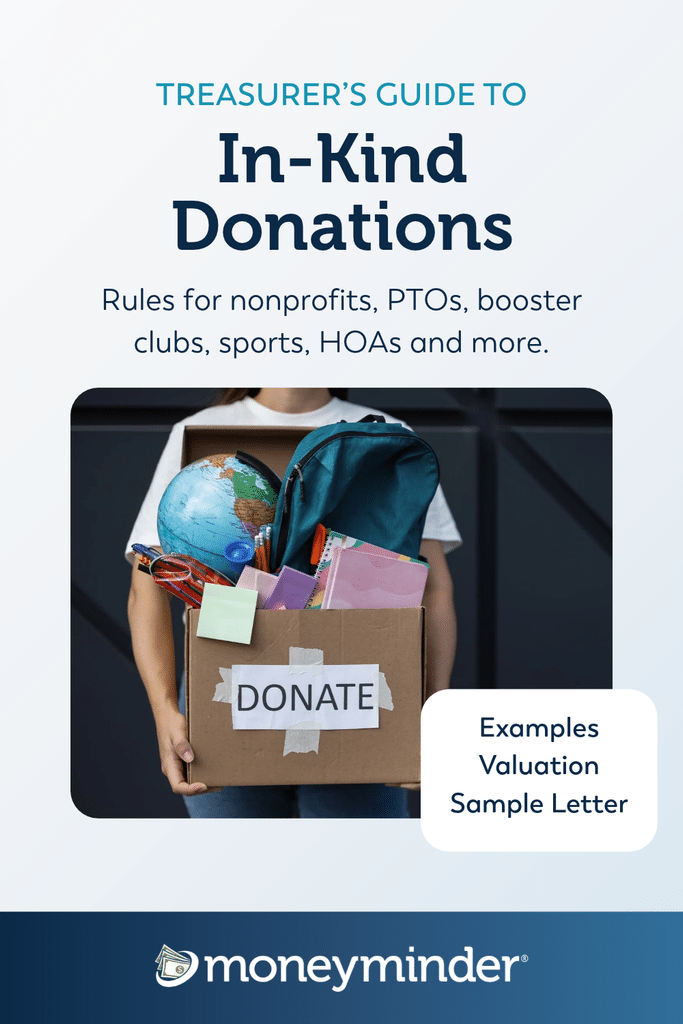
In-kind donations are non-cash contributions of goods, services, or other resources given to a nonprofit organization. Instead of contributing money, a donor provides something the nonprofit can use, such as event supplies, a raffle prize, professional services, or meeting space.
While no money changes hands, in-kind donations do have financial value. Nonprofit groups may need to determine the fair market value of in-kind donations, then record and acknowledge them appropriately.
Cash vs. In-Kind Donations: What’s the Difference?
Cash donations are gifts of money, including cash, checks, credit cards, and online payments. In-kind donations are gifts of anything else, such as goods, services, or the use of property.
| Cash donations | In-kind donations | |
|---|---|---|
| What’s given | Money | Goods, services, or use of property |
| Who sets the value | The amount given | The donor, for tax purposes; your group estimates fair market value for its own records |
| Dollar amount on the acknowledgment letter | Yes | No, describe the item instead |
| How to record it | Deposit to your bank account | Record at estimated fair market value |
For both types, donors need a written acknowledgment for any single gift of $250 or more to claim a tax deduction.
What are Some Examples of In-Kind Donations?
In-kind donations can take many different forms. Here are some examples that volunteer-led groups commonly receive.
| Category | Examples |
| Goods and equipment | A computer, furniture, sports equipment |
| Supplies and materials | School supplies, art supplies, lumber to build a bench |
| Food and beverages | Bottled water for a sports team, food for a fundraising event |
| Property rentals | Free use of a meeting room, event hall, or storage space |
| Professional services | Donated web development, graphic design, or accounting services |
| Auction and raffle items | Gift baskets, merchandise, and gift certificates |
How Do You Determine the Fair Market Value of an In-Kind Donation?
The fair market value (FMV) of an in-kind donation is how much the item, property, or asset would sell for in today’s market. Large nonprofits might need to hire a professional to get this number right. But it’s usually a little more straightforward for volunteer-run groups like PTAs, PTOs, scout troops, and booster clubs.
Let’s say a business donated a meeting room for your group’s next board meeting. You can look to see what’s normally charged to rent that property or something similar. Similarly, if you receive a donation of silent auction items, you can look online to see the retail price of the exact goods or something comparable.
Be sure to save any documentation that explains how you determined the FMV of your in-kind donations.
How Do You Record In-Kind Donations?
To record an in-kind donation, you’ll need to document what goods or services your group received, who donated them, when the donation was made, and what the estimated fair market value of the donation is. Keep any supporting documentation, such as receipts or records you used to determine the fair market value of the contribution.
If your volunteer-led organization uses MoneyMinder, you can track in-kind donations right alongside monetary contributions. This article in our Help Center walks you through how to record in-kind donations in MoneyMinder.
Do I Need to Send Acknowledgment Letters for In-Kind Donations?
Yes. Donors need a written donation receipt from your group to claim a tax deduction for any single contribution of $250 or more, and that includes in-kind gifts. They need it before they file their tax return, so plan to send letters promptly, and no later than January 31 of the following year.
Even for smaller gifts, a written thank-you is a good practice. It gives donors a record for their taxes and shows them their support made a difference.
An in-kind donation acknowledgment letter should include:
- The donor’s name
- Your organization’s full legal name
- A statement that your organization is a 501(c)(3) tax-exempt organization (if it is)
- Your organization’s employer identification number (EIN)
- The date the gift was received
- A description of the donated item or service (but not its dollar value)
- A statement of whether the donor received any goods or services in return, and if so, a description and good-faith estimate of their value
Leave the dollar value off. For in-kind gifts, the donor is responsible for valuing the donation for their taxes. Your letter should describe what was given, not what it’s worth.
Send Donation Acknowledgments Automatically with MoneyMinder
If your group uses MoneyMinder, you don’t need to write these letters from scratch. MoneyMinder generates donation acknowledgment letters from the donations you’ve already recorded. You can send one for a single gift or a year-to-date summary for each donor, customize the default template, and email or download letters for one donor or your whole list at once. Learn how to send donation acknowledgment letters in MoneyMinder.
Sample In-Kind Donation Thank-You Letter
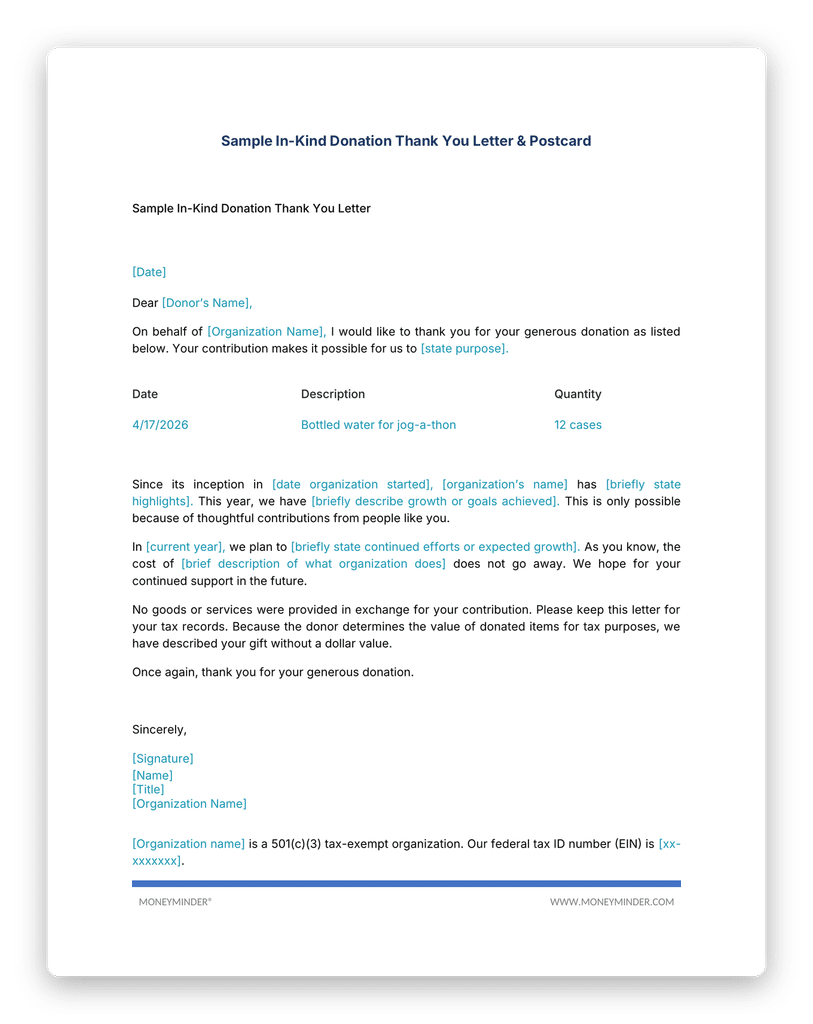
Not using MoneyMinder yet? Copy this template and fill in the details.
Not using MoneyMinder yet? Copy this template and fill in the details.
[Date]
Dear [Donor Name],
Thank you for your generous donation of [description of item or service, e.g., “a gift basket with two restaurant gift cards and a cooler”] to [Organization’s Full Legal Name], received on [date of gift].
Your gift helps us [specific impact, e.g., “raise funds for new playground equipment at our spring carnival”]. We couldn’t do it without supporters like you.
[Organization’s Full Legal Name] is a 501(c)(3) tax-exempt organization, EIN [XX-XXXXXXX]. No goods or services were provided in exchange for your contribution.
Please keep this letter for your tax records.
With gratitude,
[Name]
[Title], [Organization Name]
Track Monetary and In-Kind Donations the Easy Way
PTOs, PTAs, booster clubs, scouts, and other parent groups all depend on both monetary and in-kind donations. Tracking these different types of donations doesn’t have to be complicated.
See why volunteer-led groups rely on MoneyMinder to track donations and expenses and manage the books with ease. Start your free 30-day trial today.
Frequently Asked Questions About In-Kind Donations
If a donor gives a single in-kind contribution worth $250 or more, they need a written acknowledgment from your organization to claim a tax deduction. For non-cash gifts over $500, donors also file IRS Form 8283 with their tax return. Either way, sending a thank-you letter for every in-kind gift is a good practice.
Monetary donations are financial contributions made to a nonprofit, often in the form of cash, checks, or credit card transactions. In-kind donations are non-cash contributions and could include goods, supplies, equipment, or professional services. Both types of donations are helpful for nonprofits, but they’re managed and tracked a bit differently.
The donor and the nonprofit may both need to determine the value of an in-kind donation, but they use this information in different ways. The donor may need to determine the fair market value of their donation for tax purposes. The nonprofit, on the other hand, may need to determine an in-kind donation’s value for accounting and financial reporting purposes.
Yes, volunteer time is a form of in-kind support. That said, nonprofits generally only recognize donated services in their financial statements if the services create or enhance a non-financial asset or require specialized skills that the organization would otherwise have to pay for. For example, donated accounting services may qualify, but time spent volunteering at a school fundraiser typically wouldn’t. Volunteers can’t deduct the value of their time, but they may be able to deduct unreimbursed out-of-pocket costs, like mileage driven for your group.
If a donor contributes goods or property to a qualified nonprofit organization, it’s typically tax-deductible. The amount a donor can deduct is based on the fair market value of the donation, subject to IRS rules and limitations. However, donors typically can’t claim a tax deduction for the value of donated time or services. Donors should consult a tax professional if they have questions about whether their in-kind donations are tax-deductible.
An in-kind donation acknowledgment letter should include the donor’s name, the full legal name of the nonprofit organization, a statement of the organization’s 501(c)(3) status (if applicable), and the organization’s employer identification number (EIN). The letter should also include a description of the gift, when it was received, and whether the donor received anything in exchange for their donation. The letter shouldn’t include the dollar value of the donated items because the donor is responsible for determining that value for tax purposes.
When a donor receives something in return, like a dinner or an auction item, only the amount they pay above the item’s fair market value counts as a donation. For example, if someone pays $100 for a gala ticket and the dinner is worth $40, $60 is deductible. If a payment over $75 includes goods or services, the IRS requires you to give the donor a written statement with a good-faith estimate of what they received.
Yes. Used goods are still in-kind donations, so record them just like new items. The difference is how you value them. Fair market value for a used item is what it would sell for in its current condition, such as at a thrift or consignment store, not what it cost new. For example, a gently used laptop might be worth a fraction of its original price.
In your acknowledgment letter, describe the item and its condition (for example, “one used Dell laptop in good working condition”), but don’t include a dollar value. Donors should also know that used clothing and household items generally must be in good used condition or better to be tax-deductible.
You don’t need to record every can individually. When you receive a large volume of donated food, track it in batches instead. Weigh or count the donations as they come in, then estimate their value using a consistent method, such as a standard value per pound. Record the total as one in-kind donation for each drive or each month, and keep your intake logs as documentation.
For acknowledgment letters, most food drive donors give well under $250, so a written acknowledgment isn’t required for tax purposes. Many groups offer a simple receipt the donor can fill in with what they gave. Larger donors, like a grocery store or restaurant donating in bulk, should get a letter describing what was donated and when, but without a dollar value, just like any other in-kind gift.
This article was originally published in 2021 and updated on November 1, 2024 and November 19, 2026.