
Why HOA year-end feels different
For most HOA treasurers, year-end and the annual meeting arrive together. In the same few weeks, you’re closing the books, presenting next year’s budget, setting assessments, and possibly handing everything to a newly elected treasurer.
Homeowners are paying close attention, too. It’s their money, and many of them will read the year-end report line by line.
The good news: year-end gets much easier when you stop treating it as one big deadline. This checklist breaks it into five jobs, in the order most self-managed HOAs need to tackle them. Start about 60 days before your fiscal year ends, or before your budget meeting if that comes first.
1. Close the books
Everything else on this list depends on accurate numbers, so start here.
- Reconcile every account. That means operating, reserves, and any savings or money market accounts, plus PayPal or other payment platforms. Each one should match its bank statement through the last day of the fiscal year.
- Follow up on delinquent assessments. Send reminders before year-end, and make a list of who still owes what. Your board will want this list, and so will your next treasurer.
- Clear out loose ends. Deposit any checks sitting in a drawer. Pay outstanding vendor invoices, or note them for next year. Reimburse board members for out-of-pocket expenses they’ve submitted.
- Confirm reserve transfers happened. If your budget called for monthly or quarterly reserve contributions, make sure every one was actually moved.
- Attach the paperwork. Every expense should have an invoice or receipt, and every deposit should have a record of what it was for.
Once the books are reconciled, pull your year-end reports. At a minimum: a treasurer’s report, budget vs. actual by category, ending balances for operating and reserve accounts, and the delinquency list.
2. Prepare for review
An annual review protects the association, and it protects you. It’s the easiest way to show homeowners their money was handled properly.
What kind of review you need depends on two things: your governing documents and your state. Many states require HOAs to give owners an annual financial report. Some require a CPA review or full audit once revenue passes a certain amount. Smaller associations often use an internal review by a committee of owners who aren’t on the board.
- Check your requirements. Look at your bylaws and your state’s HOA statute for review or audit rules and any revenue thresholds.
- Line up your reviewers early. A CPA’s calendar fills fast after year-end. A volunteer committee needs time to schedule, too.
- Gather the review packet. Bank statements for every month, reconciliations, receipts and invoices, meeting minutes that approved major spending, and your year-end reports.
- Plan for findings. Most are small, like a missing receipt. Decide ahead of time how you’ll document and report them to the board.
If reviews have been skipped in past years, start now. One clean review makes every future one easier.
3. Set next year’s budget and assessments
This year’s actual numbers are the best starting point for next year’s budget. That’s why the books get closed first.
- Compare budget to actual. Note every category that ran over or under, and why. Landscaping, insurance, and utilities are common surprises.
- Check reserve funding. If you have a reserve study, compare this year’s contributions to what it recommends. If you don’t, note that for the board.
- Draft the budget. Build in known increases like insurance renewals and vendor contract changes.
- Calculate assessments. Work out what each homeowner needs to pay to cover the budget and reserve contributions.
- Follow your notice rules. Many governing documents and state laws set a deadline for sending the proposed budget or assessment changes to owners before the meeting. Check yours and work backward from it.
Present the budget with a short explanation of what changed and why. Homeowners accept an increase more easily when they can see where the money goes.
4. Handle tax and compliance
HOA tax filing works differently from most volunteer groups. Most HOAs don’t file a Form 990. Instead, they file Form 1120-H or Form 1120, usually with help from a CPA. Associations with 501(c)(4) status are the exception.
- Confirm your filing and due date. Form 1120-H is generally due on the 15th day of the fourth month after your fiscal year ends. For a calendar-year HOA, that’s April 15.
- Prepare 1099-NECs. If you paid an individual or unincorporated contractor $2,000 or more during the calendar year, such as a landscaper, handyman, or snow removal service, you’ll likely need to send them a 1099-NEC by January 31 (or the next business day if it falls on a weekend). The threshold was $600 before 2026, so check which applies to the year you’re reporting. Collect W-9s now if any are missing.
- Check state requirements. Some states require an annual corporate report or registration renewal for HOAs.
- Review insurance. Confirm your directors and officers (D&O) coverage and fidelity bond or crime coverage are current, and that coverage amounts still fit your reserve balance.
Tax rules vary by association, so check with a tax professional if you’re unsure which form applies to you.
5. Hand off to the next board
If a new treasurer is elected at your annual meeting, the handoff is the last job of your year. Done well, it means your successor can pay a bill on their first day.
- Update bank signers. Most banks ask for meeting minutes showing the election results. Remove outgoing signers at the same time you add new ones.
- Transfer every login. That includes bank accounts, payment platforms, your bookkeeping software, and any shared email or cloud storage. Change passwords as you go.
- Hand over the records. Governing documents, past budgets and reviews, insurance policies, tax filings, vendor contracts, and the homeowner roster with current balances.
- Write a handoff memo. Note what’s pending: unpaid invoices, delinquent accounts, upcoming filing deadlines, and anything unusual about the past year.
- Schedule a walkthrough. An hour together is worth more than a box of files.
If you’re staying on as treasurer, use this step anyway. Make sure at least one other board member could find everything if they had to.
Get the free HOA Year-End Treasurer Kit
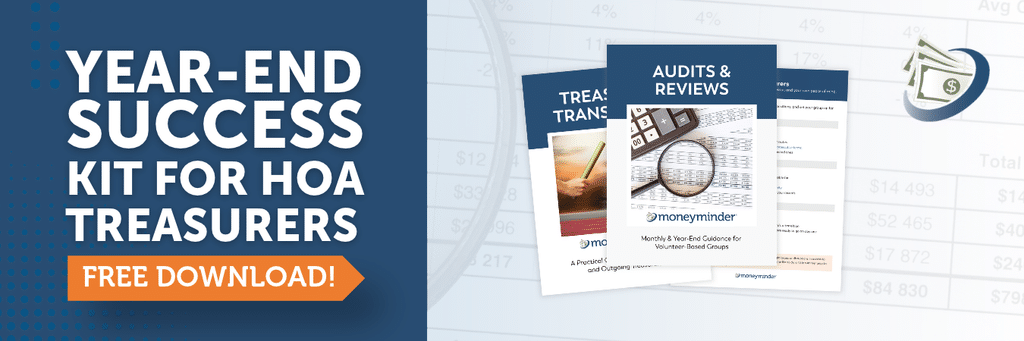
Want the printable version, plus templates for the hardest parts? The HOA Year-End Treasurer Kit includes three guides in one free download:
- Year-End Treasurer Checklist to close the books, with a 10-minute monthly mini-audit form
- Audits & Financial Reviews, with an editable review checklist, red flags, and a sample findings letter
- Treasurer Transitions Guide, with an editable handoff memo, bank signer letter, and 60-day transition timeline
Prefer to see it walked through? Join a free MoneyMinder Live Session. We’re hosting two, one for HOA Basics and one with our partners at Cheddar Up. You’ll see a step-by-step look at year-end, with questions answered by our team.

And if you’d rather spend less time on year-end next time, MoneyMinder for HOAs keeps your books reconciled, reports ready, and records in one place all year long.
FAQs
About 60 days before your fiscal year ends, or before your budget meeting if that comes first. That leaves time to reconcile, follow up on delinquent dues, and get reports to the board before they set the budget.
Usually not. Most HOAs file Form 1120-H or Form 1120 instead. Associations with 501(c)(4) status are the exception.
No. Requirements depend on your state and your governing documents. Some states require a CPA review or audit above certain revenue levels, while many smaller HOAs use an internal review by an owner committee.
A treasurer’s report, budget vs. actual by category, ending balances for operating and reserve accounts, a delinquency list, and the proposed budget for next year.